


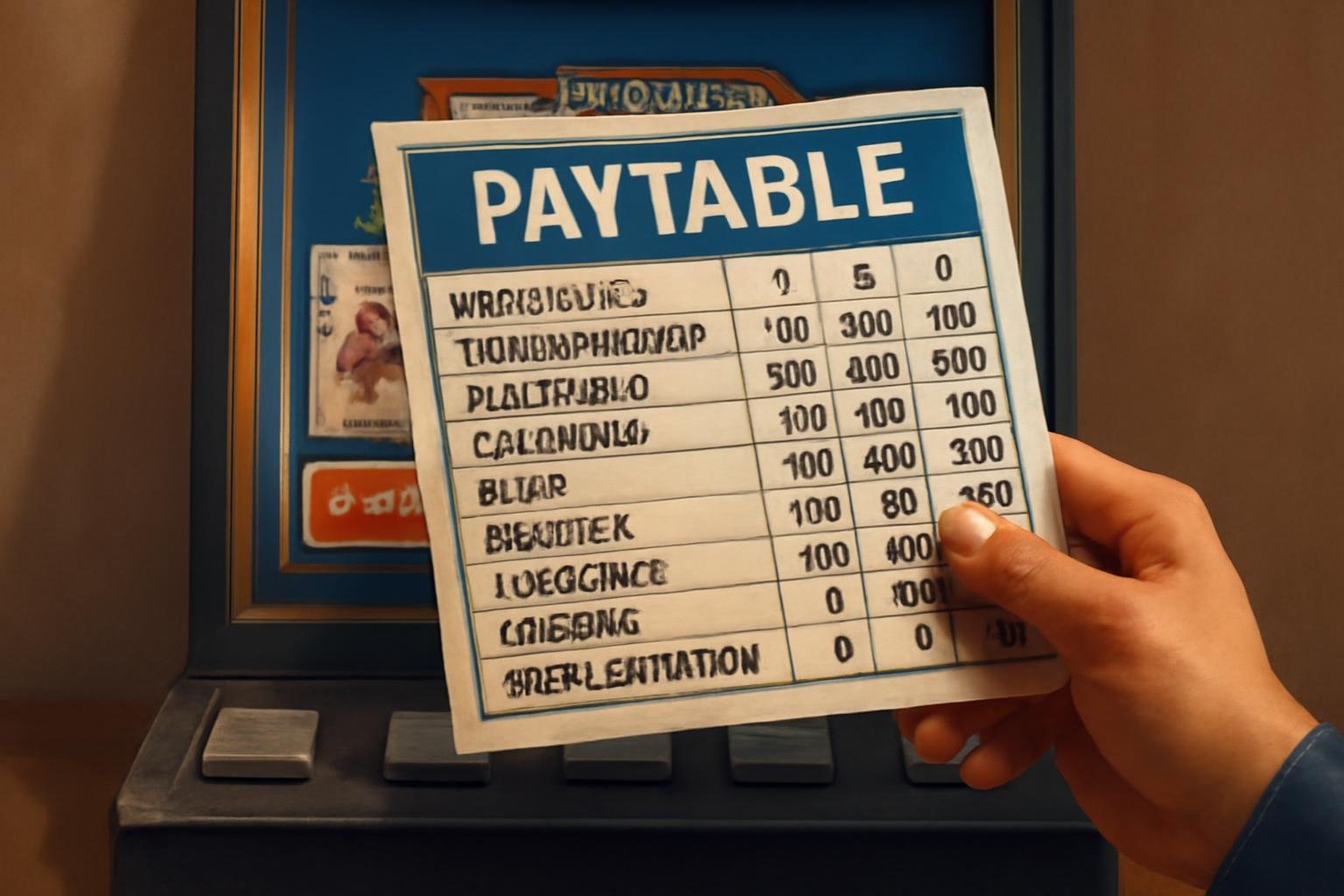
A video poker paytable tells you which hands are paid and how much each one returns. The useful skill is not memorizing every payout: it is checking that you understand the game version, the wager conditions and the values shown before you start. Two games with similar names can use different schedules, so take a moment to inspect the screen rather than relying on the title alone.
Identify the exact game and its rules
Start by reading the full game name and any rule or help screen. A label such as “Jacks or Better” identifies a familiar type of video poker, but the paytable and other rules still matter. Check which hand ranks qualify for payment and whether the game describes any special features or altered rules.
Video poker is played against a machine’s fixed hand rankings, not against other players at a table. That makes it different from conventional poker, where opponents’ actions are part of the decision. If you want background on how casino game formats differ, see this overview of casino game categories and variations.
Read the payout rows from top to bottom
The paytable usually lists winning hands in one column and their payouts beside them. Read every row, including the lowest qualifying hand, rather than focusing only on the biggest prize. The order and exact hand names depend on the game, but the table should make clear which combinations count.
Check how the figures are expressed. A payout may be displayed in credits, and the amount can depend on the number of credits wagered. Confirm the denomination of each credit as well as the total stake you are selecting. A payout figure that looks large in credits is not meaningful on its own unless you know the credit value and wager.
Check whether the wager changes a payout
Some video poker paytables show different returns at different wager levels, particularly for the top-ranking hand. Look across the wager columns or consult the help screen to see whether a special payout requires a particular bet. Do not assume that the maximum wager is required—or that it is affordable—without checking the displayed rules.
For a straightforward comparison, compare the same hand at the same wager level across games. If one table lists a payout per credit and another shows a total payout, convert them to the same basis before drawing conclusions. This avoids mistaking a difference in display format for a better schedule.
Compare the whole schedule, not one headline payout
A prominent top-hand award does not tell you how every other winning hand is paid. Review the complete schedule and note any rule changes that could affect how often hands qualify or how their returns are calculated. A table with a familiar name is not necessarily identical to another version with that name.
Published return figures, when available, are tied to a particular game and set of rules, and may also assume a particular way of playing. They describe a long-run mathematical expectation, not what will happen in a short session. A paytable cannot predict the next hand or guarantee a result.
Use a quick pre-play checklist
- Confirm the game’s full name and read its help or rules screen.
- Find the qualifying hands and check every payout row.
- Verify the credit denomination and total cost of the selected wager.
- Look for payouts that change with the wager size and note any conditions.
- Compare like with like: same game rules, hand, and wager level.
- Set a spending and time limit before playing; do not raise a wager to chase losses.
Keep video poker strategy in its own lane
General poker advice can help explain concepts such as patience, but it does not replace learning the paytable and decision rules for a specific video poker game. The games do not share the same opponent-based decisions. For broader poker reading, see an article on patience in casino poker and common mistakes involving pocket aces; treat those as table-poker topics rather than video poker instructions.
The practical takeaway: identify the exact game, understand how its figures relate to your wager, and compare the full schedule before inserting money. If a payout condition or rule is unclear, pause and check the game information instead of guessing.